The Invisible Walls – Voices for Freedom from Iran
The Berlin Wall was a visible border running through the heart of a city. It divided people, families, and an entire country. Its fall on 9 November 1989 became a global symbol of freedom and of the courage to stand up against political oppression. Berlin Freedom Week commemorates this legacy while turning our attention to a question that remains urgent today: Where are people still fighting for their freedom?
Iran has no concrete wall like the one that once divided Berlin. Yet since the establishment of the Islamic Republic in 1979, countless invisible walls have been built — walls of censorship, state violence, repression, fear, imprisonment, torture, executions, and surveillance. Despite these barriers, Iranians have never abandoned their struggle. For decades, they have repeatedly taken to the streets, calling for freedom, human rights, democracy, self-determination, and an end to the Islamic Republic.
The nationwide protests that began on 28 December 2025 reached a dramatic peak on 8 and 9 January 2026. Human rights organizations documented mass killings, injuries, and mass arrests. At the same time, internet and telecommunications access was largely shut down, cutting people in Iran off from the outside world and making it more difficult to document the violence. Amnesty International reported mass unlawful killings on an unprecedented scale.
During the protests, many Iranians carried the Iranian national flag used before the 1979 Islamic Revolution. For parts of the Iranian opposition, the movement was described as the “Lion and Sun Revolution” — an expression of the struggle for a free, democratic, and self-determined Iran.
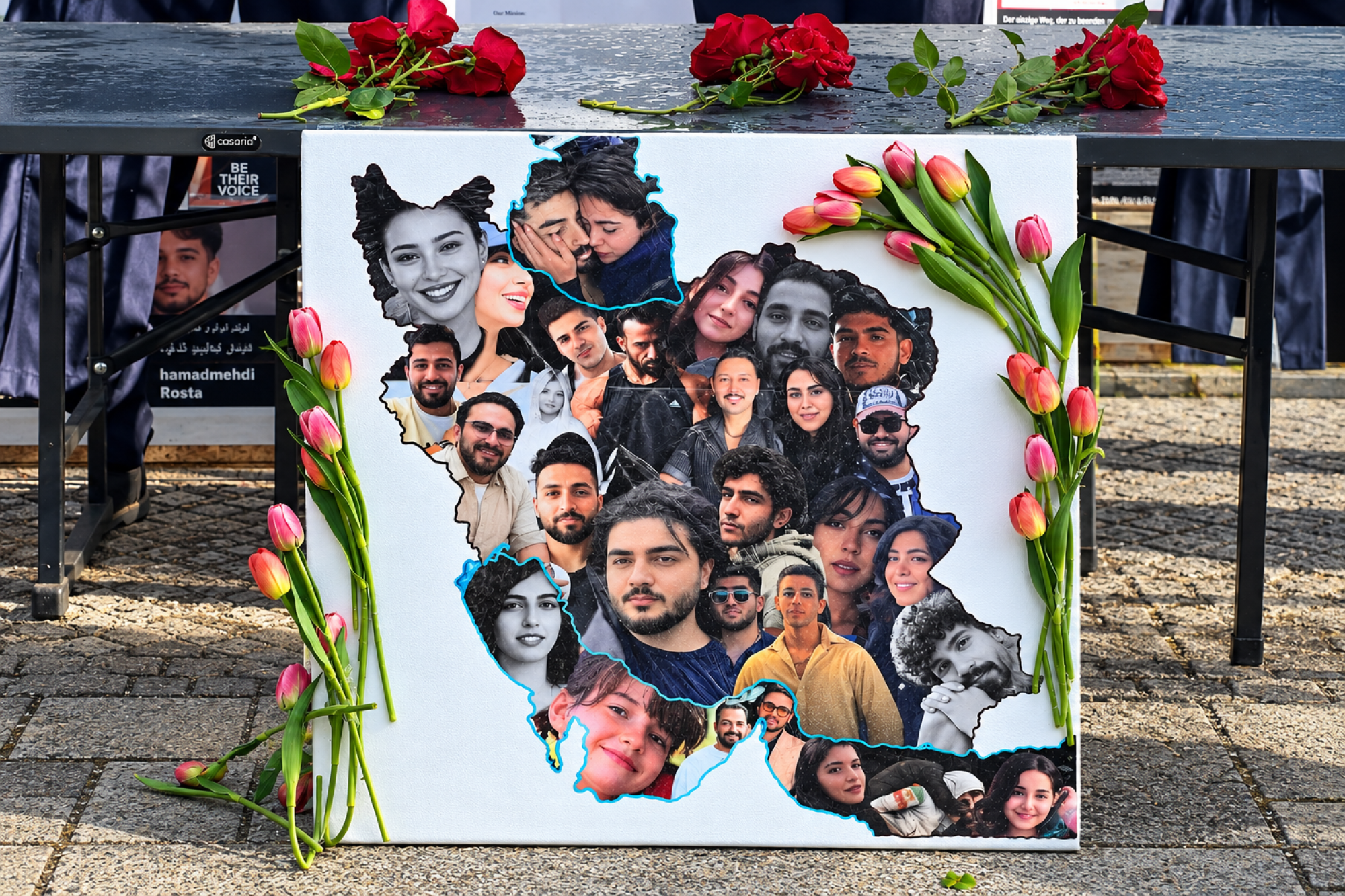
Our exhibition puts faces to the people behind these events. We present photographs, names, and personal stories of people who lost their lives in the struggle for freedom, as well as those who became victims of repression, imprisonment, and torture. The exhibition also features selected excerpts, suitable for a public audience, from the four-part documentary This Is Our Story by Manoto TV.
At the heart of the event is a simple question: “What would you write on the wall?”
Visitors are invited to leave their own messages for freedom on a symbolic wall. These messages will then be translated into Persian and shared through our social media channels with our Iranian audience — a reminder that, even behind the walls of the Islamic Republic, voices calling for freedom can still be heard.
Location:
Across from Deutscher Bundestag
Paul-Löbe-Allee, 10557 Berlin